In the panel presentation that my group gave on Kindred, the author Sarah Schiff proposed the idea that historical fiction can be used as a tool for healing communities within our country by creating common historical memories. I found this idea interesting--the idea that a book could have so much power that it could help mend relationships between racial and gender divides.
I'm skeptical of this idea mainly because these issues obviously are deeply rooted in society and there are so many different angles to the problem and fiction isn't the only thing that can solve the problems, but I think Schiff does have a good point. Books like Kindred make the historical ideas something much more personal to the reader--something a regular historical textbook probably can't do. Obviously, some fictional liberties had to be taken to write such a novel, but perhaps this fiction can tell us more about 1800s slave plantations than a textbook can. By having a character that we can emotionally relate to, the issues of slavery and race are no longer distant things you read about in a historical textbook. The characters of history seem more human. And this then forces us to take history more seriously when we think of these historical characters as people, instead of merely as facts and data we read about in a textbook.
Schiff argued that this way of telling history then allowed the readers--regardless of gender and race--to rebuild a historical memory that is more accurate than ones from textbooks. According to her, historical fiction, in a way, tells more truths than facts by conveying ideas etc. This common historical memory would then pave the way for more civil conversations and a common understanding of traumatic issues from the past, and it would help people accept their history and move on together instead of staying divided over small factual details and hard feelings. Quite optimistic, but altogether not a bad idea.
Check out the rest of the article here.
Friday, April 18, 2014

Friday, March 14, 2014
.jpg)

Friday, February 28, 2014
Is the Narrative Clip art?
How to use the Narrative Clip and App from Narrative on Vimeo.
It's time to geek out on photography, again.
When Mr. Mitchell brought up the Narrative Clip in class the other day I was intrigued by the idea of carrying around a camera that constantly shot photos. I was also a little bit creeped out by it. I somehow thought that once you wore it that it became a permanent fixture and you never ever took it off (Turns out, if you put it in your pocket it shuts off.). After doing a bit more research, the Narrative Clip sounds like a fun idea--though it isn't without it's downfalls.
The actual specs of the camera say it's only 5mp quality. Current iPhone camera quality is 8mp, so this narrative clip takes pictures about the same as older and more annoying android phones. Most of your indoor photos will end up looking grainy because of the low light, and in general the lower quality makes for worse editing and cropping. The clip takes a square photo, much like taking a shot for Instagram. But, apparently there are some lenses you can buy to help with the square picture issue. [Examples of photos taken with narrative clip: A, B, C]
One of the major downsides to technology like this is that it makes everyone too self aware that they're taking photos. This then makes every living moment of their lives a potential "Facebook moment," as I'll call it, a moment when you think to yourself "Oh, this would make a good [insert social media tool name here] post! This would get tons of likes from my friends!" Thus usually motivating you to take out your phone and get the perfect shot, and then upload it with a witty caption. You're no longer living your life for you, but instead you're living life for the 560 friends you have on Facebook, the 60 followers you have on your blog, and the 120 people who subscribe to your YouTube account. Smartphones already do this to some extent today. Humans long to mean something, and social networking gives us a chance to be whatever hero we want to be--we can sculpt our own image. Social media is a wonderful invention, but it can be overused to the point where you base your life's worth off of what your internet persona is and not the life it's reflecting.
On the other hand, the Narrative Clip can be an amazing way to document important moments in our lives. It would be so cool to have a few people wearing this at a wedding, a birthday party, or a family reunion to collect more personal pictures of the events. You could wear the narrative clip on traveling trips too. For someone who is horrible at journaling during trips (There's always something more interesting to be doing!), this tool would be invaluable for capturing all the small moments and details of being in a new country. The GPS would also come in handy with a map of your travels.
The Narrative Clip is a fun idea, but I would argue that the photos it produces aren't necessarily works of art. The only way for the Narrative Clip to be art is if the user has a specific artistic purpose for the photos captured. You lose the art of photography when it becomes this automatic and monotonous snap of a photo. There is no artist behind it--it's just an empty box taking a photo every thirty seconds. Yes, some photos will turn out cool looking, but they aren't art. It's like when people see weird post-modern art and go "I could do that in kindergarten! That's just a blank canvas and a string attached to it!" The answer is, no, you couldn't.
Art has thought and meaning behind it. It isn't the robotic reflex that the Narrative Clip turns it into. The art of photography is setting just the right manual settings on the camera, positioning it to get the right shot and frame the object in the photo, and hitting the shutter at just the right moment. The artist looks through the viewfinder and sees something beautiful or fascinating that they can give meaning to. Others look and see only a "Facebook moment" and the 20 notifications waiting for them after they upload their shot.
Tuesday, February 25, 2014
Researching Reed
Our conversations in class today made me interested to see what Ishmael Reed himself had to say about his work. So I did some digging and here are some of the things I found.
This section of Conversations with Ishmael Reed, is interesting to read because he responds to how some critics interpreted his book Mumbo Jumbo, and he also comments on how he sees 1920s America parallel to current America.
Here is another interview that delves into Reed's ideas on writing and politics. From everything I've seen so far, Reed is a very opinionated person who is not afraid to have his opinion made known.
Reed has also written many opinion articles for the New York Times and a journalism website called Counterpunch. Although they don't have much to do with Mumbo Jumbo, these articles can give us insight as to how he thinks about things. And, he does have his own website where you can find even more information if you're still looking for it at this point.
This section of Conversations with Ishmael Reed, is interesting to read because he responds to how some critics interpreted his book Mumbo Jumbo, and he also comments on how he sees 1920s America parallel to current America.
"The only thing I can conclude is that my book caused these critics to hallucinate"And if that quote doesn't get you reading that interview, I don't know what will.
Here is another interview that delves into Reed's ideas on writing and politics. From everything I've seen so far, Reed is a very opinionated person who is not afraid to have his opinion made known.
"I'm not some pathetic token standing before the settler cultural committee pleading 'Choose me. Choose me.' The kind of "minority" literature promoted by the white academic establishment, which controls what students read, includes images and plots that are no different from the kind of stereotypes we get on TV. These people don't know how much their tokens are despised in their own communities. My interest in African religion in this hemisphere is the same as the enthusiasm the Irish writers had toward a Celtic revival, or contemporary Asian American writers have in texts written in Kanji, or Hispanic writers in Aztec, or Toltec. Writers try to renew precolonial traditions all over the world. "I found a JSTOR article where Reed talks about minstrelsy, post-modernism, and modernism and much more, of course. It's rather long to read, but interesting nonetheless.
I talked in the Nickel Review about technology, and I said in 1967 that technology would be the black writer's boon. Nam June Paik has said that Rock and Roll is the U.S.'s greatest export, and Hip Hop, Rap and other manifestations of black culture, or black technology, are being marketed all over the world for billions of dollars,very little of which is being seen by its creators. Think also of how black technology influences post-modernism, Ron Sukenick's experiments with Voodoo, the performance art of Laurie Anderson, Twyla Tharp, Heavy Metal, the downtown New York scene; how Jazz influenced people like Jackson Pollock. With software publishing and new high tech video technology we will go to town. With video we can leap beyond the racist film distribution networks, right into the living room
...
I just don't think that I've been influenced all that much by modernism. I've been interested in the forms they use, the discontinuity, but many years ago I discovered that these ideas were not originated by modernists. I think that avantgarde movements tend to take themselves too seriously and believe that they are originating forms which are, in fact, ancient.And finally on page 10 of Sharon Jesse's essay Ishmael Reed's Multi-Culture: The Production of Cultural Perspective, she references an interview where Reed gives his motivation for writing historical history. (I couldn't find the actual book with the real interview online, so this'll have to do. If you wanted to know more I guess you could always check out the book from the library.)
In an interview with John O'Brien, Reed says that he and other minority artists "aim" their questioning at "those who supply the nation with its mind... the people involved in culture," but that what he and other artists want is "to sabotage history" so that the "Historical Establishment" "won't know whether we're serious or whether we are writing fiction... Always keep them guessing"---
Reed has also written many opinion articles for the New York Times and a journalism website called Counterpunch. Although they don't have much to do with Mumbo Jumbo, these articles can give us insight as to how he thinks about things. And, he does have his own website where you can find even more information if you're still looking for it at this point.
Postmodern art adventure
I watched this a few days ago and thought it fit well into the post-modernist way of thinking about art where art can be anything as long as it holds significance for someone and leads you to a new understanding of something. Also goes along with the idea where if you have to question it then of course it's art. (This explanation may sound vague, but, then again, so does the definition post-modernism...)
Also, the medium itself is post-modern because this video series is running on YouTube, and anyone with a camera and a YouTube account is invited to join in and share in their experiences with this project.
This particular Art Assignment involves two people coming together to meet in the exact middle between their two current locations. The video itself explains this idea further, but basically the "art" assignment is having two people travel to a set location. So how is that art? At 3:00 the creator of the Art Assignment project, Sarah Green, explains that this project is in fact art because "art doesn't have to be an object--or material. It can be something like ... triggers for experiences instead." I found this to echo some post-modernists' ideas on art.
One example that came to my mind when Sarah Green said this was Bruce Nauman's piece called "Body Pressure," which is, at first glance, just some blank drywall on the wall.
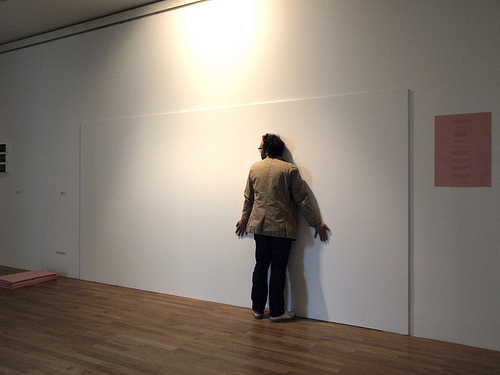
Apparently, this is a very introspective art piece that helps the participant focus on their own body. I was talking to Jia about this and she said that thinking about how the body is pressed against the wall, what muscles are tensed, how skin deforms against the wall, and how the wall is touching you is supposedly very meditative.
Monday, February 10, 2014
A brain explosion and the aftermath
Here are my current thoughts on history and fiction. I don't pretend like I have anything figured out yet, but I wanted to get some ideas written out because these questions have been annoying me since the beginning of this class. Especially annoying is that history is what I want to study in college, so I would like to figure out what these things mean because they have actual application to my future (scary, right?).
I may or may not come back to this later in the semester... We'll see if any of my thoughts change... I just wanted a place to write and figure out exactly where I stand with respect to this new postmodernist weirdness.
If you bother to read this, I'm interested to hear any thoughts you might have on these questions.
Sunday, February 9, 2014
I only have a small obsession with quotes
Apparently postmodernists weren't the first ones to challenge the validity of history.
I laugh at the irony in that we can't be certain whether these historical quotes are accurate either.
I laugh at the irony in that we can't be certain whether these historical quotes are accurate either.
"The very ink with which history is written is merely fluid prejudice." — Mark Twain
"History is more or less bunk" — Henry Ford
"What is history but a fable agreed upon?" — Napoleon Bonaparte
"Historian: an unsuccessful novelist" — H. L. Mencken
"History is an account, mostly false, of events, mostly unimportant, which are brought about by rulers, mostly knaves, and soldiers, mostly fools." — Ambrose Bierce
"History is a gallery of pictures in which there are few originals and many copies." — Alexis de Tocqueville
"History is a cyclic poem written by time upon the memories of man." — Percy Bysshe Shelly
Subscribe to:
Posts (Atom)