Showing posts with label art. Show all posts
Showing posts with label art. Show all posts
Friday, February 28, 2014
Is the Narrative Clip art?
How to use the Narrative Clip and App from Narrative on Vimeo.
It's time to geek out on photography, again.
When Mr. Mitchell brought up the Narrative Clip in class the other day I was intrigued by the idea of carrying around a camera that constantly shot photos. I was also a little bit creeped out by it. I somehow thought that once you wore it that it became a permanent fixture and you never ever took it off (Turns out, if you put it in your pocket it shuts off.). After doing a bit more research, the Narrative Clip sounds like a fun idea--though it isn't without it's downfalls.
The actual specs of the camera say it's only 5mp quality. Current iPhone camera quality is 8mp, so this narrative clip takes pictures about the same as older and more annoying android phones. Most of your indoor photos will end up looking grainy because of the low light, and in general the lower quality makes for worse editing and cropping. The clip takes a square photo, much like taking a shot for Instagram. But, apparently there are some lenses you can buy to help with the square picture issue. [Examples of photos taken with narrative clip: A, B, C]
One of the major downsides to technology like this is that it makes everyone too self aware that they're taking photos. This then makes every living moment of their lives a potential "Facebook moment," as I'll call it, a moment when you think to yourself "Oh, this would make a good [insert social media tool name here] post! This would get tons of likes from my friends!" Thus usually motivating you to take out your phone and get the perfect shot, and then upload it with a witty caption. You're no longer living your life for you, but instead you're living life for the 560 friends you have on Facebook, the 60 followers you have on your blog, and the 120 people who subscribe to your YouTube account. Smartphones already do this to some extent today. Humans long to mean something, and social networking gives us a chance to be whatever hero we want to be--we can sculpt our own image. Social media is a wonderful invention, but it can be overused to the point where you base your life's worth off of what your internet persona is and not the life it's reflecting.
On the other hand, the Narrative Clip can be an amazing way to document important moments in our lives. It would be so cool to have a few people wearing this at a wedding, a birthday party, or a family reunion to collect more personal pictures of the events. You could wear the narrative clip on traveling trips too. For someone who is horrible at journaling during trips (There's always something more interesting to be doing!), this tool would be invaluable for capturing all the small moments and details of being in a new country. The GPS would also come in handy with a map of your travels.
The Narrative Clip is a fun idea, but I would argue that the photos it produces aren't necessarily works of art. The only way for the Narrative Clip to be art is if the user has a specific artistic purpose for the photos captured. You lose the art of photography when it becomes this automatic and monotonous snap of a photo. There is no artist behind it--it's just an empty box taking a photo every thirty seconds. Yes, some photos will turn out cool looking, but they aren't art. It's like when people see weird post-modern art and go "I could do that in kindergarten! That's just a blank canvas and a string attached to it!" The answer is, no, you couldn't.
Art has thought and meaning behind it. It isn't the robotic reflex that the Narrative Clip turns it into. The art of photography is setting just the right manual settings on the camera, positioning it to get the right shot and frame the object in the photo, and hitting the shutter at just the right moment. The artist looks through the viewfinder and sees something beautiful or fascinating that they can give meaning to. Others look and see only a "Facebook moment" and the 20 notifications waiting for them after they upload their shot.

Tuesday, February 25, 2014
Postmodern art adventure
I watched this a few days ago and thought it fit well into the post-modernist way of thinking about art where art can be anything as long as it holds significance for someone and leads you to a new understanding of something. Also goes along with the idea where if you have to question it then of course it's art. (This explanation may sound vague, but, then again, so does the definition post-modernism...)
Also, the medium itself is post-modern because this video series is running on YouTube, and anyone with a camera and a YouTube account is invited to join in and share in their experiences with this project.
This particular Art Assignment involves two people coming together to meet in the exact middle between their two current locations. The video itself explains this idea further, but basically the "art" assignment is having two people travel to a set location. So how is that art? At 3:00 the creator of the Art Assignment project, Sarah Green, explains that this project is in fact art because "art doesn't have to be an object--or material. It can be something like ... triggers for experiences instead." I found this to echo some post-modernists' ideas on art.
One example that came to my mind when Sarah Green said this was Bruce Nauman's piece called "Body Pressure," which is, at first glance, just some blank drywall on the wall.
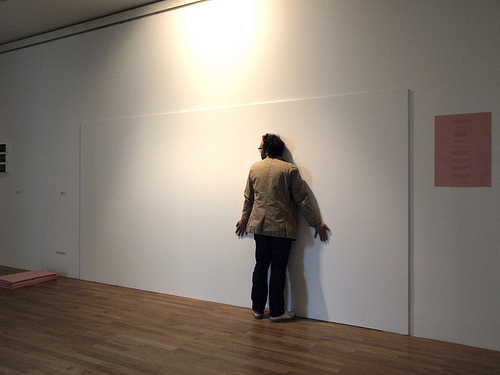
Apparently, this is a very introspective art piece that helps the participant focus on their own body. I was talking to Jia about this and she said that thinking about how the body is pressed against the wall, what muscles are tensed, how skin deforms against the wall, and how the wall is touching you is supposedly very meditative.
Thursday, August 22, 2013
Maybe Aurelius was wrong
Here are three of my favorite examples of how artists rework trivial objects in life to make them into beautiful art projects.
Similar to how Nicholson Baker is able to write a book out of one lunch hour and make it interesting and relatable, these artists take commonplace items and habits and express them in a way that makes you appreciate the beauty of even the simple things in life.
Similar to how Nicholson Baker is able to write a book out of one lunch hour and make it interesting and relatable, these artists take commonplace items and habits and express them in a way that makes you appreciate the beauty of even the simple things in life.
 |
| Cerise Doucède's Égarements and Quotidien |
 |
| Yayoi Kusama's Obliteration Room |
 |
Giuseppe Colarusso's Unlikely project |
The artistic qualities of a fork
 |
| I think my most successful photo from my experiment was this photo of three forks and a spoon. |
The class discussion today talked about how The Mezzanine turns the mundane, trivial, everyday consumer items into art by putting "a blank wall" around them--much like how a museum displays its art.
By isolating the objects and talking about them in detail, Howie is forcing us to focus only on the object. He rants about straws, paper towels, and even garbage trucks. Somehow, he turns these commonplace items into objects of wonder and curiosity. Howie says that he wants to "set the escalator to the mezzanine against a clean mental background as something fine and worth my adult time to think about," and I think he succeeds in getting the reader to think more creatively about day to day life.
This point of the book, and the discussion in class, reminded me of a photo experiment that I did last winter.
I'm not a photographer by any stretch of the imagination, but at one point last year I really wanted to try out a homemade light box for my food blog that I was writing for nonfiction writing class. The goal was to make the food items look even more delicious by casting more light onto them, because usually well-lit subjects make a better picture.
I found that taking pictures of the food was so much fun that I started grabbing things in the kitchen, and I found that when these trivial objects are placed on their own in the light box you suddenly see colors and shapes that you hadn't noticed before. And, now that I think about it, my use of the light box was similar to Howie's discovery of the rusted railroad spike in the well-swept garage.
For example, the blue on the Earl Grey tea packet stands out in one picture, and so do the colors of the twisty straws in the next.
Most of the time, when I make tea I don't even study the packet at all because I promptly discard it, but on it's own the packet is suddenly fascinating. I begin to notice that the packet is made of this papery plastic material. I also notice the shadows its crinkled shell casts, the fading color of dark blue and black on the design, and my ultimate betrayal of the "please tear here" instructions.
The twisty straws also become intriguing because they remind you of the swirly motion that occurs as you drink liquid through them. The white milk twists and turns, and your eyes cross as they look down your nose to examine the effect the twisty straw has on the drinking time of the liquid (only a few hundredths of a second more drinking time than using a regular straw).
Howie would probably go into great detail about why and how twisty straws came into existence, but I'll save the extensive footnotes for another time.
If you're interested here are some the shots that I came up with:


Subscribe to:
Posts (Atom)