Here is an interesting interview with Toni Morrison on Song of Solomon.
Towards the end of the video she mentions why she wanted Milkman to be obsessed with escaping and flying, and that was what I found most interesting because she tells us why she wanted to write the story in the first place.
One thing I love about listening to interviews with authors is that you get to understand why they wrote what they did, and what they were thinking when they wrote it. You find out why it is significant to them and their lives. Sometimes I feel like we over analyze things in English classes, and I often find myself wondering what the author really was thinking and whether or not we interpret it completely differently.
That's the cool thing about any creative art form--everyone has their own interpretations based on how they connect to the book and sometimes these interpretations differ from the author's. That doesn't mean that we're wrong, but I do like getting to know the author's perspective on their work. (Too bad Shakespeare is dead because I would have had loads of questions for him about his plays.)
Friday, December 13, 2013

Make me a bird
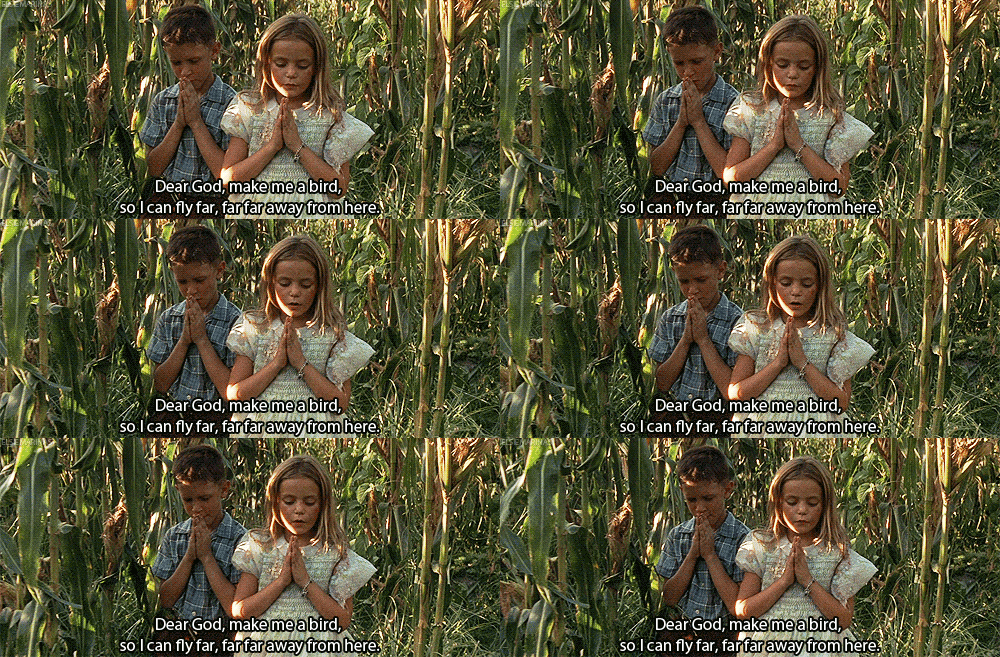 |
| Milkman's desire to fly away reminded me of Jenny in "Forrest Gump," only Milkman's motivations are quite different from Jenny's. |
It's this loss of an interest in himself and an imagination that creates the unambitious and lazy Milkman in the next few chapters of the novel. Milkman is only looking out for his own safety, and he never really grows up because he isn't looking at himself critically on an introspective level. Milkman doesn't change because he doesn't think the change is necessary because he doesn't realize that a problem exists in the first place. He doesn't see the problem because he still has no interest in himself and refuses to examine his character.
Deep down, all Milkman wants to do is escape. He wants to fly away and create a life different than that of the people back home. He hates the thought of becoming more like his father. Flight is the potential of the future, the great unknown--like the horizon beyond the hood ornament of the winged woman. Milkman wants to conquer this unkown future, but he doesn't want to give up his comfort at home. This leaves him stuck.
This urge to escape is also a sign of immaturity on Milkman's part. He would rather run from problems than confront them, and he can get away with this because he is rich enough to afford a plane ticket. For example, when asked what he would do if he lived in Alabama amidst the rampant racism, Milkman responds that he would grab a plane ticket and fly away as quickly as he could. He doesn't think about solving some of his family issues, or trying to mend things with his friends, but instead takes a plane far away on a selfish quest for gold.
The ironic thing is that the more Milkman tries to fly away, the more he is reminded of and brought back to his family. He flies away to Pennsylvania and meets all of these people who tell him stories of his family. Also, Milkman is basically still carrying out his father's orders to find the gold, so he hasn't yet escaped his father's influence.
Milkman can't fly away, because it's like Guitar said "Wanna fly, you got to give up the shit that weighs you down." Milkman hasn't given up the things weighing him down. The things weighing him down, are his own ideas on privilege. He can't move forward in life because he is still stuck in the world where he has enough money to do whatever he wants. Milkman hasn't realized that there is more to life than money and personal safety and security.
Perhaps Milkman will finally mature in the last few chapters of the novel. I'm excited to see how his character will (or won't) grow by the end of the novel. I have a theory though, that the song
Sugarman done fly, Sugarman done gone
Sugarman cut across the sky, Sugarman gone
will have something to do with Milkman and the ending of the book.
Wednesday, December 11, 2013
Creative Project: Antoinette's Insanity
 | |
| "But above all the thick walls, keeping away all the things that you have fought till you can fight no more. Yes, maybe that's why we all stayed -- Mrs Eff and Leah and me. All of us except that girl who lives in her own darkness." (Rhys 178) |
 |
| "I'll say one thing for her, she hasn't lost her spirit. She's still fierce. I don't turn my back on her when her eyes have that look. I know it." (Rhys 178) |
 |
| "In the end flames shoot up and they are beautiful. I get out of bed to watch them and to wonder why I have been brought here. For what reason? There must be a reason. What is it I must do?" (Rhys 179) |
 |
| "So there is still the sound of whispering that I have heard all my life, but these are different voices." (Rhys 180) |
 |
| "When she is snoring I get up and I have tasted the drink without colour in the bottle. The first time I did this I wanted to spit it out but I managed to swallow it. When I got back into bed I could remember more and think again. I was not so cold." (Rhys 179) |
 |
| "There is no looking-glass here. and I don't know what I am like now. I remember watching myself brush my hair and how my eyes looked back at me. The girl I saw was myself yet not quite myself. Long ago when I was a child and very lonely I tried to kiss her. But the glass was between us -- hard, cold, and misted over with my breath. Now they have taken everything away. What am I doing in this place and who am I?" (Rhys 180) |
 |
| "Then I open the door and walk into their world. It is, as I always knew, made of cardboard. I have seen it before somewhere, this cardboard world where everything is colored brown or dark red or yellow that has no light in it. As I walk along the passages I wish I could see what is behind the cardboard." (Rhys 181) |
 |
| "She met another girl and the second girl said, 'Have you seen a ghost?' -- 'I didn't see anything but I thought I felt something.' -- 'That is the ghost,' the second one said and they went down the stairs together." (Rhys 182) |
 |
| "I took the red dress down and put it against myself. 'Does it make me look intemperate and unchaste?' I said. [...] But I held the dress in my hand wondering if they had done the last and worst thing. If they had changed it when I wasn't looking. If they had changed it and it wasn't my dress at all -- but how could they get the scent?" (Rhys 186) |
 |
| "Time has no meaning. But something you can hold like my red dress, that has meaning [...] The scent that came from the dress was very faint at first, then it grew stronger. The smell of vetivert and frangipanni, of cinnamon and dust and lime trees when they are flowering. The smell of sun and the smell of rain." (Rhys 185) |
 |
| "I let the dress fall to the floor [...] I looked at the dress on the floor and it was as if the fire had spread across the room. It was beautiful and it reminded me of something I must do. I will remember I thought. I will remember quite soon now." (Rhys 186-187) |
 |
| "I wished to see it clearly so I lit all the candles, and there were many. I lit them carefully from the one I was carrying but I couldn't reach up to the chandelier. I looked round for the altar for with so many candles and so much red, the room reminded me of a church." (Rhys 188) |
(The quote here is taken from Antoinette's nightmare, so I tried to make the photo dream like. Here, she is sleeping among many candles, seemingly floating in mid air. )
 |
| "I waited a long time after I heard her snore, then I got up, took the keys, and unlocked the door." (Rhys 190) |
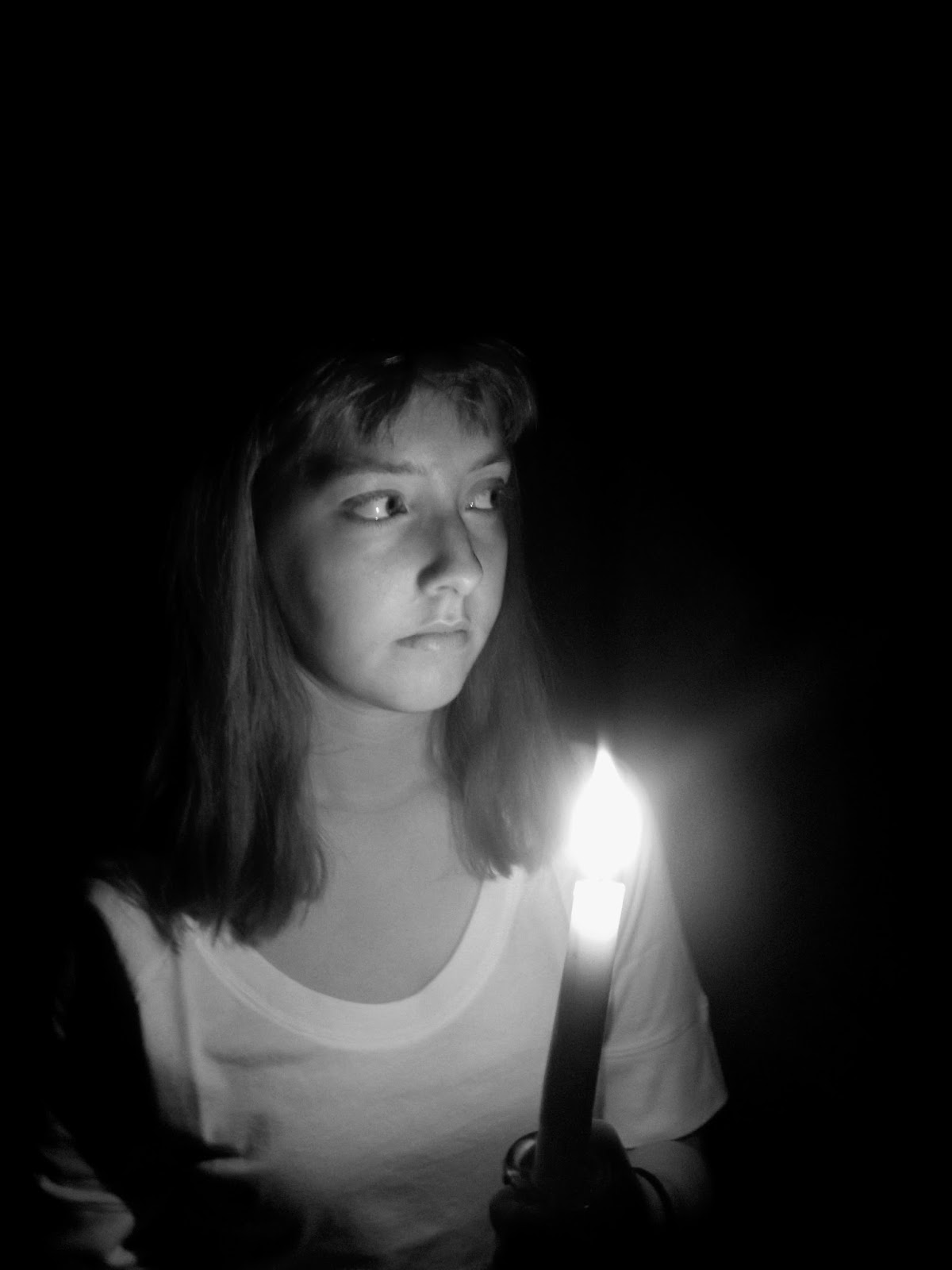 |
| "I was outside holding my candle. Now at last I know why I was brought here and what I have to do." (Rhys 189) |
 |
| "There must have been a draught for the flame flickered and I thought it was out. But I shielded it with my hand and it burned up again to light me along the dark passage." (Rhys 189) |
Friday, November 15, 2013
Antoinette + Rochester = Catastrophe
There has been lots of class discussion about Rochester and Antoinette's relationship. Has Rochester ever loved Antoinette and could he ever love her? Could their relationship have ever been a healthy one?
I think that their relationship was never, and never could have been, true love. And, I think most of the blame for this falls on Rochester's shoulders.
Yes, I understand that Rochester comes from a frivolous English background and he expects everything to go his way because that's how he's been brought up, but this isn't a good enough defense for his actions in the book.
First of all, Rochester is driven by his selfishness. He comes to the island for the sole purpose of getting a girl and a fortune--and he finds that in Antoinette. Right from the beginning Rochester doesn't love Antoinette but instead decides to lead her on by pretending that he cares for her so that she will marry him. When Antoinette tries to back out of the wedding, Rochester promises her safety and peace if they got married, but these are lies that he tells so that she will go through with the wedding (78-79). Why is he so concerned about her backing out of the wedding? Because he doesn't want to look like a poor fool to his friends back in England.
Rochester also never respected Antoinette. He calls her other names like "Bertha" and doesn't really try to understand Antoinette. He just judges her through his narrow English worldview, and is annoyed when she doesn't act English enough.
Finally, the way he responds to Christophine's ranting also makes me think that he never really loved Antoinette. After Christophine remarks about Rochester fooling Antoinette into thinking he loved her so that he could get the money, Rochester says "It was like that, I thought. It was like that. But better to say nothing. Then surely they'll both go and it will be my turn to sleep [...]" (152). Here Rochester is actually admitting that he never loved Antoinette.
Rochester never actually cared if the relationship worked out in the first place. He just wanted his money and a wife, he didn't want any emotional attachment that came with it. I have little sympathy for such a character who uses others to get what he wants, and then blames his problems on others. Rochester has little excuse to blame his problems on Antoinette. It was his choice to travel to the islands, his choice to marry Antoinette, and his choice to neglect their relationship. Rochester is not a victim in this story, Antoinette is.
I think that their relationship was never, and never could have been, true love. And, I think most of the blame for this falls on Rochester's shoulders.
Yes, I understand that Rochester comes from a frivolous English background and he expects everything to go his way because that's how he's been brought up, but this isn't a good enough defense for his actions in the book.
First of all, Rochester is driven by his selfishness. He comes to the island for the sole purpose of getting a girl and a fortune--and he finds that in Antoinette. Right from the beginning Rochester doesn't love Antoinette but instead decides to lead her on by pretending that he cares for her so that she will marry him. When Antoinette tries to back out of the wedding, Rochester promises her safety and peace if they got married, but these are lies that he tells so that she will go through with the wedding (78-79). Why is he so concerned about her backing out of the wedding? Because he doesn't want to look like a poor fool to his friends back in England.
Rochester also never respected Antoinette. He calls her other names like "Bertha" and doesn't really try to understand Antoinette. He just judges her through his narrow English worldview, and is annoyed when she doesn't act English enough.
Finally, the way he responds to Christophine's ranting also makes me think that he never really loved Antoinette. After Christophine remarks about Rochester fooling Antoinette into thinking he loved her so that he could get the money, Rochester says "It was like that, I thought. It was like that. But better to say nothing. Then surely they'll both go and it will be my turn to sleep [...]" (152). Here Rochester is actually admitting that he never loved Antoinette.
Rochester never actually cared if the relationship worked out in the first place. He just wanted his money and a wife, he didn't want any emotional attachment that came with it. I have little sympathy for such a character who uses others to get what he wants, and then blames his problems on others. Rochester has little excuse to blame his problems on Antoinette. It was his choice to travel to the islands, his choice to marry Antoinette, and his choice to neglect their relationship. Rochester is not a victim in this story, Antoinette is.
Friday, November 1, 2013
Stuck
 | |
| Frazz Comic from 10/31/13 |
I remember reading the first bit that we were assigned to read, and I was certain that this book was going to be hilarious. The beginning was funny. This guy wakes up a bug and all he can think about is his work? I kept imagining him waking up and crossing his little bug arms in sudden frustration as he says to himself "Huh, that's weird. But how am I supposed to get to work today?" Trying to explain why I found this funny is hard because when I do explain what I find funny, people look at me and go "what kind of sick person are you?! This man just tragically turned into a bug and you're laughing?"
Those who criticized my chuckles at the first few pages will be pleased to know that as the book went on I found it less humorous and more painful. The story of Gregor being rejected from the family, and gradually losing all connections to humanity, was rather sad and tragic to read. Reading it from Gregor's perspective I yearned for some of the other characters to somehow make him feel less lonely, but I also understood that it is difficult to socialize with a bug.
I hadn't ever read this book before and I wasn't sure what to expect. I kept waiting for Gregor to return to his human self, but he never did. It's like how the Frazz comic puts it--Gregor couldn't get out of his bug body. I think that this small bit of hope for a happy ending is what made me keep turning the pages. I wanted a happy ending with Disney-esk morals that the main character learns after a hard life as a bug. Sadly, the true love's transforming kiss never came for Gregor.
In the end though, I'm almost glad that Gregor died. It makes for a more interesting book, maybe not a more satisfying ending, but interesting in the fact that it makes you think more about what you read. You discover that Gregor wasn't the only one who went through a transformation, but everyone else in the family did too. His sister grew up, his dad got a job, and they finally got the courage to move out and start over. So was his death really a bad thing in the end?
Friday, October 25, 2013
Go home Meursault--you're drunk
I think that one of the reasons why there is so much conflict in the sixth chapter of The Stranger is because Meursault is drunk, and this impairs his ability to think clearly about what he is doing. He is no longer the passive, nonchalant character from the first few chapters but instead displays emotion as he forgets to put on his apathetic act.
Also, the way Meursault describes the beach and the hot summer day is very surreal and almost dream-like. This is because he was drunk and not seeing the world as clearly as before. He comments on the fact that he has a piercing headache and can't stand the hot sunlight. Maybe this was because he was dehydrated and the alcohol in his system also caused him to get sick. (I looked this up, and apparently drinking too much on a hot summer day makes you more likely to get heat illnesses.)
Perhaps Meursault's drunkenness is the reason why he chooses to shoot the man four more times than necessary. This is also an example of Meursault feeling emotion because he says that the four shots created unhappy emotions for him: "Then I fired four more times at the motionless body where the bullets lodged without leaving a trace. And it was like knocking four quick times on the door of unhappiness. "
All the same, I don't think that the fact that he was drunk makes his crime any less serious. It would be false to say "Oh, well. He was drunk so he didn't actually mean to kill anybody." What I do think is interesting, though, is seeing this second side to Meursault where he shows at least a small bit of emotion (fear/judgement/unhappiness).
Aside from the fact that Meursault tells us that he drank tons of wine during their beach picnic, there are other hints that Meursault is not in his usual state of mind as he has been before.
In this chapter, for the first time we see Meursualt taking sides in an argument instead of just passively watching and calling things "interesting." Perhaps being drunk makes Meursault forget the fact that he's supposed to be "emotionless." Not reacting to things emotionally must take a great deal of thought and effort, and in his sober state Meursault is used to being able to filter out his emotions completely. But, once he is drunk he is no longer able to filter things normally.
This is evidenced through the fights with the men who follow Raymond and Meursault to the beach. Meursault seems to have some sort of emotional investment in the fights because instead of standing back and not fighting he takes a side with Raymond. This is a first, because in other conflicts he has never really intervened but merely watched (e.g. when Raymond beats his girlfriend and when the old man beats his dog). In the beach fights, though, Meursault looks out for Raymond by yelling "Look out, he's got a knife!". This not only shows that he was on Raymond's side, but that he was somehow emotionally invested enough to want to warn Raymond of the weapon.
Also, the way Meursault describes the beach and the hot summer day is very surreal and almost dream-like. This is because he was drunk and not seeing the world as clearly as before. He comments on the fact that he has a piercing headache and can't stand the hot sunlight. Maybe this was because he was dehydrated and the alcohol in his system also caused him to get sick. (I looked this up, and apparently drinking too much on a hot summer day makes you more likely to get heat illnesses.)
Perhaps Meursault's drunkenness is the reason why he chooses to shoot the man four more times than necessary. This is also an example of Meursault feeling emotion because he says that the four shots created unhappy emotions for him: "Then I fired four more times at the motionless body where the bullets lodged without leaving a trace. And it was like knocking four quick times on the door of unhappiness. "
All the same, I don't think that the fact that he was drunk makes his crime any less serious. It would be false to say "Oh, well. He was drunk so he didn't actually mean to kill anybody." What I do think is interesting, though, is seeing this second side to Meursault where he shows at least a small bit of emotion (fear/judgement/unhappiness).
Friday, October 18, 2013
Reading books to read minds
I was listening to NPR a week or so ago and I heard a Story of the Day podcast that was about the study that found that reading literature makes you more socially adept by enhancing your ability to perceive the thoughts and feelings of people around you. I thought immediately of The Sun Also Rises.
The study compared what they called popular fiction novels, books with predictable plots and common tropes, and literary fiction which tends to be more focused on complex character development and hidden meanings. Many times, readers have to infer what's going on in literary novels.
The scientists found that the people who read literary fiction did better on tests of mind reading, and the group who read popular fiction did about as well as people who hadn't read anything at all. The explanation for this was that reading books is like immersing yourself in a new world of social interaction, and that even though it is a fictional one you still go through some of the same analysis and thinking when reading literary fiction that you do when interacting in real life.
I think Ernest Hemingway is a good example of this kind of literary fiction that makes you think critically about human interaction. The Sun Also Rises is a great example of a book that requires much inference to be fully understood. The iceberg effect that Hemingway uses means that you almost have to read the book twice to get all the references and small details that are important to how the story unfolds.
The Sun Also Rises is a book that revolves completely around social interaction with ironic subtext that the reader has to decipher. Jake's narration gives more background understanding and also interprets the conversations that he has with the people around him. One good example of this is all of the meaning behind Jake's last words of the novel: "Yes, isn't it pretty to think so?". Throughout the entire book, the reader has to interpret Jake's narration to figure out how exactly his judgements and biases influence the story.
Perhaps this was one of the reasons why I didn't like the book very much when we first began reading. I didn't pick up on all of the small details, and I couldn't understand how a story like this would be interesting. It seemed to have little plot aside from various relationship conflicts and drinking at bars. After all the class discussions, though, the book became more interesting as we made connections and inferred what was going on in the story.
I personally think that it's cool to think that after reading literary fiction we're better at mind reading. It almost makes me want to go out and read a bunch of literary fiction just so that I can be a mind reader and (if I may reference Mrs. Dalloway just once more) be able to know people by instinct like Clarissa Dalloway felt she could.
The study compared what they called popular fiction novels, books with predictable plots and common tropes, and literary fiction which tends to be more focused on complex character development and hidden meanings. Many times, readers have to infer what's going on in literary novels.
The scientists found that the people who read literary fiction did better on tests of mind reading, and the group who read popular fiction did about as well as people who hadn't read anything at all. The explanation for this was that reading books is like immersing yourself in a new world of social interaction, and that even though it is a fictional one you still go through some of the same analysis and thinking when reading literary fiction that you do when interacting in real life.
I think Ernest Hemingway is a good example of this kind of literary fiction that makes you think critically about human interaction. The Sun Also Rises is a great example of a book that requires much inference to be fully understood. The iceberg effect that Hemingway uses means that you almost have to read the book twice to get all the references and small details that are important to how the story unfolds.
The Sun Also Rises is a book that revolves completely around social interaction with ironic subtext that the reader has to decipher. Jake's narration gives more background understanding and also interprets the conversations that he has with the people around him. One good example of this is all of the meaning behind Jake's last words of the novel: "Yes, isn't it pretty to think so?". Throughout the entire book, the reader has to interpret Jake's narration to figure out how exactly his judgements and biases influence the story.
Perhaps this was one of the reasons why I didn't like the book very much when we first began reading. I didn't pick up on all of the small details, and I couldn't understand how a story like this would be interesting. It seemed to have little plot aside from various relationship conflicts and drinking at bars. After all the class discussions, though, the book became more interesting as we made connections and inferred what was going on in the story.
I personally think that it's cool to think that after reading literary fiction we're better at mind reading. It almost makes me want to go out and read a bunch of literary fiction just so that I can be a mind reader and (if I may reference Mrs. Dalloway just once more) be able to know people by instinct like Clarissa Dalloway felt she could.
Subscribe to:
Posts (Atom)